

Danchi Days finds beauty in the things time leaves behind

I love it when a game comes out that I’ve been looking forward to for a while. There’s something special about finally getting your hands on the story beyond a demo, and nothing quite compares to that excitement for me. I first played the Danchi Days demo in Summer 2025, and now that the full game is here, I’ve fallen in love all over again.
Danchi Days is a game of two halves. On one hand, you’ve got the cozy pastel pixel art that’s nostalgic and comforting. On the other, there’s the story of an aging woman and the Danchi that ages with her, the rediscovery of forgotten memories, and the perseverance of human connection in an increasingly disconnected world.
The personality of a Danchi

I didn't know what a Danchi was before I first played the demo of Danchi Days last year, but it didn't take me long to figure it out. A Danchi is essentially an apartment complex that becomes almost an enclosed community with its own traditions and unspoken rules, serving as the backdrop to entire lives for perhaps generations. The people that live there breathe so much life into the Danchi that it almost becomes a being in its own right, albeit a concrete and glass one.
In the past, these apartment complexes and little communities were common all around the world. People knew each other, relied on one another, and went about their lives knowing they had people around them who cared. In modern times, people seem to have become less open with their neighbors, choosing to make their communities online instead of with those in the same street. I'm guilty of this. I know my immediate neighbors, but I couldn't tell you who lives in the houses beyond those attached to my own.
Danchi Days is, in a way, a tale of what happens to those types of communities when people give up on each other and start to forget what it's like to have relationships with those around them. It's a story of perseverance, memory, and breathing new life into a community by bringing back the things time seems to have forgotten.
Learning to connect

While the story very much focuses on community building and bringing people together to honor forgotten traditions, there’s a lot of the modern world in Danchi Days too. Hoshino has just returned from America, where her father went to work for a big computer company, and he's bringing a modern type of internet connection with him.
Everyone has a homepage and a blog, which is where you find most of the clues to help you figure out how to convince some of the more hesitant residents to attend the Summer Festival. For me, and probably many others, this system of getting to know your neighbors through their online presence feels both familiar and nostalgic. The homepages themselves give off almost early-2000s MySpace vibes.
That nostalgia for a simpler time, both in real life and on the internet, really stands out to me while playing Danchi Days, but it’s not all happy and charming. Underneath all of the pastel colors and happy moments, there’s a tale of perseverance that manages to be both deeply sad and deeply hopeful.
Remembering the past
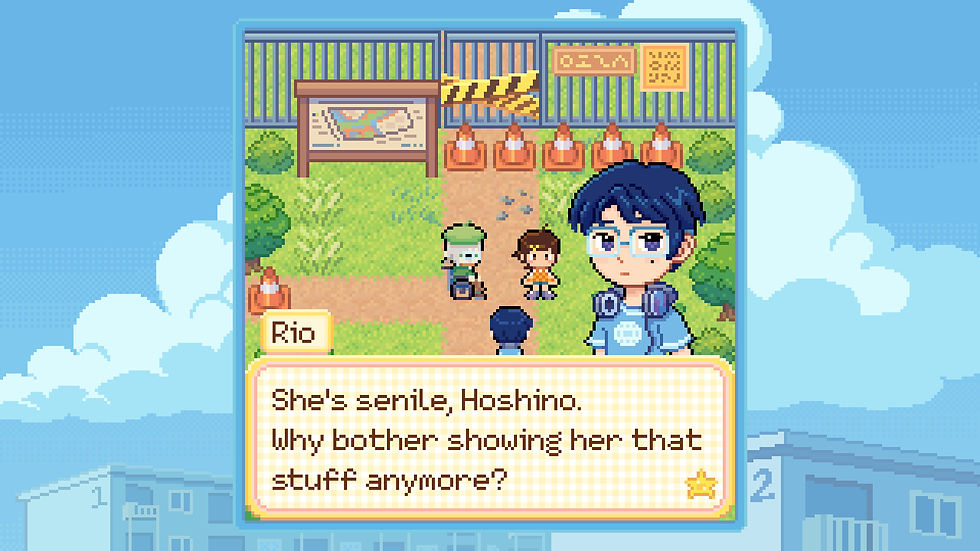
In a metaphorical previous life, I worked in healthcare. I primarily worked with dementia patients in their own homes, helping them and their families adapt and understand life with this horrible illness. Maybe that's why I sometimes found myself almost agreeing with Rio when he tried to make Hoshino see reason. But despite myself, Hoshino’s pure hope and determination are contagious, and I could never quite bring myself to think what she's trying to do is a bad idea.
The thing is, Hoshino’s actions seem to be based in reality, at least in my experience. After diagnosis, family members are often willing to try anything to reverse the illness and bring their loved one back to who they have always been. Hoshino’s idea that bringing back something Kimiko once ran and loved so much will restore her to how she used to be is realistically fruitless, but there's something deeper underneath it that makes a lot of sense.
Bringing back the Summer Festival is not going to cure Kimiko’s illness; nothing can, but I don't think that's the point of Danchi Days. It's about the danchi itself, the people within it and their combined histories. It's about the power of keeping those memories and traditions alive and bringing them to a new generation even when those who made them are beginning to forget. It's about hope and community, even in sad times, and of course, finding wonder in the mundane.
It's that blind and fierce hope, along with the gorgeous pastel color scheme, that keeps Danchi Days feeling light despite the heavy story it focuses on. You can't help but get swept up in the magic that Hoshino is bringing to the danchi, and along the way, you start believing it might actually work, though perhaps not in the way she originally intended.
Danchi Days was developed by Sandy Powder, Melos Han-Tani, and Mogumu, and it was released on October 29. It’s a truly touching tale wrapped in pastel and hope, and I highly recommend playing it if you’re feeling nostalgic and want something to restore your faith in community. There’s also a demo available to play right now on Steam.


Comments